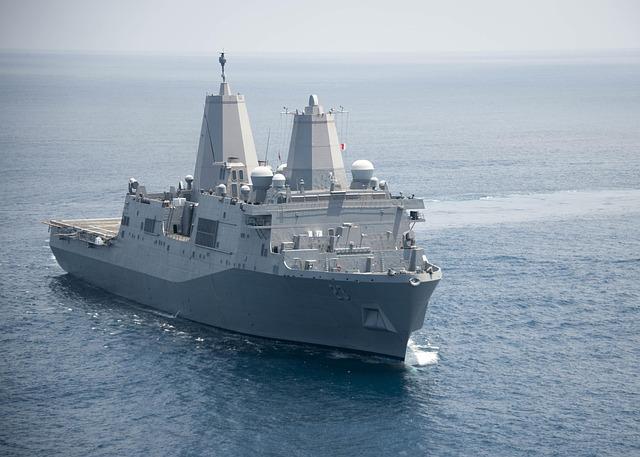
France has bolstered its naval presence in the East Mediterranean by deploying an additional Landing Helicopter Dock (LHD) and a frigate to the region, sources report. The move underscores Paris’s commitment to maintaining security and stability amid escalating tensions in this strategically vital area. The deployment, detailed by navalnews.com, highlights France’s effort to support regional allies and safeguard its interests in a complex geopolitical landscape.
France Strengthens Naval Presence in East Mediterranean Amid Rising Tensions
In a strategic move reflecting escalating regional complexities, France has dispatched an additional Landing Helicopter Dock (LHD) and a modern frigate to bolster its naval operations in the Eastern Mediterranean. The deployment underscores Paris’s commitment to maintaining maritime stability and upholding freedom of navigation amid intensifying disputes over territorial waters and energy exploration rights. These assets are expected to enhance France’s rapid response capabilities, facilitate joint exercises with allied navies, and provide critical support for humanitarian and security missions in the area.
Key elements of the deployment include:
- The LHD, equipped with advanced aviation facilities and amphibious capabilities, will serve as a command hub and force projection platform.
- The frigate, featuring state-of-the-art air defense and anti-submarine warfare systems, provides robust escort and surveillance functions.
- Collaboration efforts with NATO and regional partners to monitor evolving maritime threats and ensure safe passage for commercial vessels.
| Vessel | Type | Main Role | Deployment Duration |
|---|---|---|---|
| Tonnerre | LHD | Amphibious Operations & Air Support | 6 months |
| Auvergne | FREMM Frigate | Air Defense & Anti-Submarine Warfare | 6 months |
Capabilities and Strategic Value of the Deployed LHD and Frigate Explored
The deployment of the French Landing Helicopter Dock (LHD) and frigate to the East Mediterranean marks a significant enhancement in the operational capabilities of the region’s naval forces. The LHD, with its extensive aviation facilities, amphibious assault capability, and command-and-control systems, reinforces France’s ability to project power and provide humanitarian assistance rapidly. Its ability to launch and recover helicopters and unmanned aerial vehicles (UAVs) offers superior situational awareness and flexibility in multi-domain operations, essential for monitoring complex geopolitical environments.
The accompanying frigate complements the LHD by providing a sophisticated platform for air defense, anti-submarine warfare, and surface combat operations. Equipped with advanced radar systems and missile technologies, it acts as a force multiplier, securing maritime approaches and enabling sustained naval presence. Key capabilities include:
- Enhanced air and missile defense: Protecting vital assets against aerial threats.
- Anti-submarine warfare: Deploying sonar systems and torpedoes to counter underwater threats.
- Force projection and maritime security: Enabling presence and deterrence in contested waters.
| Vessel | Primary Role | Key Capability | Operational Advantage |
|---|---|---|---|
| Landing Helicopter Dock (LHD) | Amphibious operations and aviation support | Helicopters & UAV deployment | Rapid power projection and humanitarian aid |
| Frigate | Surface combat and maritime defense | Advanced missile systems | Securing sea lanes and air defense |
Regional Implications and Responses from Neighboring Countries
The deployment of additional French naval assets to the East Mediterranean has triggered a range of strategic calculations among neighboring states. Countries such as Greece and Cyprus have publicly expressed cautious support, viewing the bolstered French presence as a stabilizing force amid growing regional tensions. Conversely, Turkey has condemned the move, interpreting it as a provocation that could escalate existing maritime disputes. This complex geopolitical environment has prompted several nations to reassess their own maritime strategies and diplomatic postures, reinforcing the delicate balance of power in the Mediterranean basin.
In response, alliances are being subtly recalibrated as Mediterranean countries seek to safeguard their interests. Notably, Egypt and Israel have intensified naval exercises with Greece and France, signaling a potential shift towards deeper security cooperation. This multifaceted regional alignment is further complicated by energy exploration activities and contested territorial waters. Below is a summary of key regional actors’ initial reactions to the French naval deployment:
- Greece: Welcomes additional French forces; views as deterrence against regional threats.
- Turkey: Strongly opposes deployment; labels it as interference and escalatory.
- Cyprus: Supports French presence to protect Exclusive Economic Zone (EEZ) interests.
- Egypt & Israel: Increasing joint naval coordination in response to evolving security dynamics.
| Country | Position | Response Action |
|---|---|---|
| Greece | Supportive | Joint naval drills with France |
| Turkey | Opposed | Diplomatic protests, increased naval patrols |
| Cyprus | Supportive | Formalized maritime security agreements |
| Egypt | Neutral-Engaged | Enhanced coordination with regional allies |
Recommendations for NATO Coordination and Enhanced Maritime Security Measures
To fortify maritime security in the East Mediterranean, it is essential that NATO enhance its operational coordination through regular joint exercises and real-time intelligence sharing. Enhanced interoperability between naval forces could be achieved by adopting standardized communication protocols and harmonizing rules of engagement. Additionally, establishing a unified maritime surveillance center equipped with advanced AIS and radar technologies will improve early threat detection and response capabilities. Emphasizing the integration of cyber-defense measures within naval operations will safeguard critical communication channels against emerging hybrid threats.
Key focus areas for NATO coordination include:
- Real-time intelligence fusion across member states
- Joint training drills and simulation exercises
- Standardized operational protocols for rapid deployment
- Enhanced cyber-security frameworks for naval assets
| Measure | Expected Outcome |
|---|---|
| Unified Surveillance Center | Improved situational awareness |
| Joint Naval Exercises | Increased interoperability |
| Shared Cyber Defense Protocols | Resilience against cyber-attacks |
| Standard Communication Protocols | Seamless multi-nation coordination |
Closing Remarks
As tensions continue to simmer in the East Mediterranean, France’s decision to deploy an additional Landing Helicopter Dock (LHD) and frigate underscores its commitment to maintaining stability and safeguarding its strategic interests in the region. This move not only reinforces France’s naval presence but also highlights the evolving dynamics among key Mediterranean actors. Observers will be watching closely to see how this deployment influences regional security and diplomatic engagements in the weeks to come.