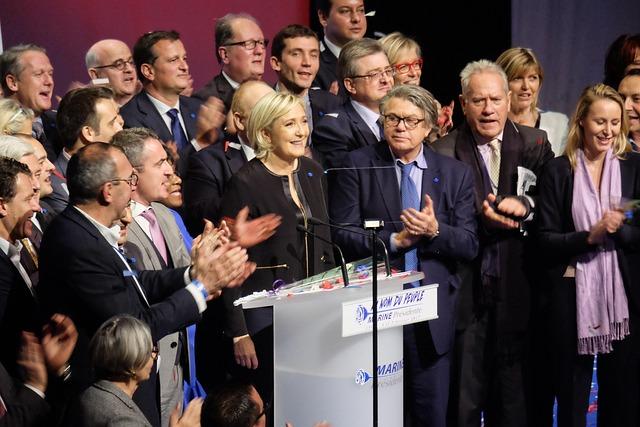
In recent years, Marine Le Pen has dramatically reshaped her political image, transforming from a fringe nationalist figure into a formidable contender within French politics. Central to this evolution has been her unexpected success in courting the support of Corporate France—a sector traditionally wary of her party’s protectionist and populist rhetoric. This article explores how Le Pen recalibrated her message and strategy to appeal to business elites, unraveling the complex dynamics behind her growing influence among France’s corporate leadership, and what this means for the country’s political and economic landscape.
Marine Le Pen’s Strategic Shift to Appeal to Corporate Interests
Marine Le Pen’s recent recalibration marks a significant departure from her party’s traditional populist rhetoric, veering towards a more polished and corporate-friendly image. This shift is characterized by a deliberate softening of her stance on economic nationalism and protectionism, now emphasizing incentives for business innovation, deregulation, and tax reliefs aimed explicitly at enticing large multinational firms and influential business leaders. Her campaign has actively courted CEOs and chamber of commerce groups, blending nationalist themes with rhetoric that champions “French entrepreneurial excellence,” an approach designed to realign her party with the aspirations of Corporate France.
Behind the scenes, this strategic overhaul includes targeted messaging adjustments and policy proposals crafted to reassure corporate stakeholders of her commitment to market stability and growth. Key elements of her pitch include:
- Reduction in corporate tax burdens, signaling a move away from overt anti-business policies.
- Promotion of public-private partnerships in sectors like energy and infrastructure.
- Commitment to maintain the eurozone membership, calming fears about financial volatility.
- Enhanced intellectual property protections to foster innovation.
These tactical shifts translate into a calculated effort to dilute the hardline image that once alienated much of the business elite, paving the way for a broader coalition that includes France’s economic heavyweights.
Unpacking the Business Community’s Growing Affinity for Le Pen
Marine Le Pen’s shifting image has increasingly resonated with segments of France’s corporate elite, signaling an unexpected realignment in political sympathies. Traditionally wary of her National Rally’s protectionist and sovereigntist rhetoric, many business leaders are now drawn to her pragmatic stance on economic nationalism and state intervention. Le Pen’s recent pivot towards policies that promise to safeguard French industries from global competition, while advocating for strategic government support, has struck a chord amid rising uncertainties in international markets and supply chain disruptions. This recalibration presents her not merely as a fringe nationalist but as a potential steward of French economic resilience in a turbulent geopolitical landscape.
Economic considerations play a central role in this newfound affinity. Key corporate players appreciate Le Pen’s calls for strengthening domestic production and revisiting trade agreements that, in their view, undermine national sovereignty and labor standards. Moreover, her proposals to reform taxation and social welfare systems, designed to protect both businesses and workers, have fostered cautious optimism among entrepreneurs who perceive a convergence of interests. The following table highlights some of the core policy areas where Le Pen’s platform aligns with business concerns:
| Policy Area | Le Pen’s Proposal | Business Appeal |
|---|---|---|
| Trade | Renegotiate EU trade deals | Protect local industries |
| Tax | Lowering corporate tax on reinvested profits | Encourage investment |
| Labor | Improve vocational training | Skilled workforce development |
| Regulation | Streamline bureaucracy | Faster decision-making |
- Strategic economic nationalism appeals to companies seeking stability amid global disruptions.
- Advocacy for tighter regulation of foreign investments reassures businesses worried about national control.
- State-led support for innovation and industry revitalization aligns with corporate growth ambitions.
Policy Proposals That Resonate With France’s Economic Elites
Marine Le Pen’s recent policy proposals have struck a chord with many figures within France’s business community, a shift that challenges traditional political alignments. Key among her propositions is a focus on economic nationalism, advocating for the protection of domestic industries through selective tariffs and incentives for “Made in France” products. This approach promises a revitalization of manufacturing sectors that have long been under pressure from globalization, offering corporate elites a narrative of sustainable national growth paired with strengthened sovereignty.
Additionally, her platform includes a simplification of tax codes aimed at alleviating the burden on small and medium-sized enterprises (SMEs), an often-overlooked segment that forms the backbone of the French economy. These policy measures portray a pragmatic side of Le Pen’s economic vision, appealing to those concerned about market competitiveness and operational efficiency. Below is an overview of select proposals and their perceived benefits:
| Proposal | Benefit to Corporate France |
|---|---|
| Protective Tariffs on Key Imports | Shield domestic manufacturers from foreign competition |
| Tax Simplification for SMEs | Reduce administrative costs and encourage entrepreneurship |
| Investment in National Infrastructure | Improve logistics and reduce business operation costs |
| Support for Strategic Industries | Ensure long-term economic resilience |
Recommendations for Corporate Leaders Navigating Political Alignment
Corporate leaders today face an intricate dilemma when engaging with politically charged environments, especially amidst rising populism like that championed by Marine Le Pen. To maintain corporate integrity while navigating political currents, executives must adopt a stance of strategic neutrality. This involves carefully assessing the political landscape with a focus on long-term business impacts rather than short-term gains. Transparency remains key: openly communicating company values and avoiding overt endorsements that could alienate stakeholders or damage brand reputation. Leaders should also foster internal dialogues that emphasize diversity of thought, ensuring that corporate policies reflect a broad spectrum of viewpoints.
Practical measures can guide executives through this complex terrain:
- Conduct industry-wide impact assessments to understand how political shifts affect market stability.
- Engage with bipartisan advisory boards that help balance perspectives before taking public stances.
- Implement robust corporate social responsibility (CSR) frameworks that transcend political affiliations and appeal to universal ethical standards.
- Monitor media narratives and public reception closely to recalibrate messaging dynamically.
| Risk Factor | Recommended Action | Potential Outcome |
|---|---|---|
| Polarization in Consumer Base | Neutral public messaging | Mitigated loss of customers |
| Regulatory Uncertainty | Active lobbying with diverse political groups | Increased policy influence |
| Reputation Vulnerability | Strengthened CSR initiatives | Improved public trust |
In Conclusion
In tracing Marine Le Pen’s evolving relationship with Corporate France, it becomes clear that her political strategy has extended beyond traditional populist appeals. By courting business interests and softening her party’s image, Le Pen has managed to gain a foothold within circles that once viewed her with suspicion. This shift marks a significant recalibration in the French political landscape, posing new questions about the future alliances between nationalist politics and economic power. As the 2024 elections approach, the impact of this rapprochement will be closely watched, with potential ramifications not only for France but for broader European economic and political dynamics.